Korea Minimal Infographic Banner Vector: A Practical Guide to Modern Cultural Design
In the evolving landscape of digital design, the intersection of cultural heritage and modern aesthetics has created a unique niche for visual communication. The Korea Minimal Infographic Banner Vector represents this synthesis, offering designers and content creators a streamlined way to present complex information about Korean culture without overwhelming the viewer. Unlike traditional, ornate designs that rely heavily on dense patterns and saturated colors, these minimal vectors prioritize negative space, clean lines, and symbolic clarity. This approach not only aligns with contemporary web standards but also ensures that cultural elements remain recognizable and respectful within a professional layout.
For general consumers, business owners, and creative professionals, understanding the utility of these assets goes beyond simple decoration. It involves recognizing how specific illustrative elements—such as palaces, food, fans, and national symbols—can be leveraged to tell a cohesive story. Whether you are designing a travel blog, an educational presentation, or a corporate report on market trends in Seoul, the right vector asset serves as both a functional container for data and an aesthetic anchor for your audience.
Deconstructing the Visual Vocabulary
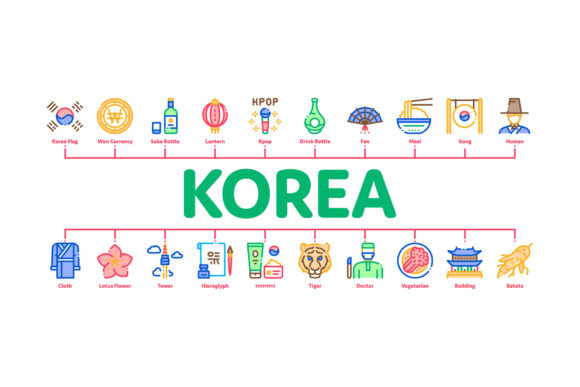
To effectively utilize a Korea Traditional Minimal Infographic Web Banner Vector, one must first understand the semiotics embedded within the artwork. These vectors are rarely random collections of clip art; they are curated sets of symbols that convey specific meanings. When evaluating a vector pack, look for the following core components and understand their best applications:
- Palace Buildings and Gongs: Architectural elements like the curved eaves of Gyeongbokgung or the stylized silhouette of a traditional gong serve as excellent headers or section dividers. In a minimal style, these are often reduced to line art or flat geometric shapes, making them perfect for backgrounds where text readability is paramount. They evoke history, stability, and institutional authority.
- Food and Drink Illustrations: Kimchi, bibimbap, soju, and tea sets are universally recognized markers of Korean lifestyle. In infographic design, these icons function best as bullet points or data visualization markers. For example, a tourism statistic regarding culinary experiences can be anchored by a minimalist bowl icon rather than a generic chart, instantly contextualizing the data.
- Fans and Lanterns: These elements introduce movement and softness to rigid grid layouts. A folding fan can act as a dynamic shape mask for images or text boxes, while lanterns provide vertical rhythm in long-form web banners. They are particularly useful for sections discussing festivals, arts, or evening entertainment.
- Korea Flag and Wearing (Hanbok): National identity markers require careful handling. Minimalist interpretations of the Taegeukgi (flag) or Hanbok clothing avoid visual clutter while maintaining immediate recognition. These are ideal for introductory slides, "About Us" sections, or demographic breakdowns where cultural identity is the primary focus.
Technical Formats: Choosing Between JPG and EPS
A critical aspect of working with these assets is understanding file formats. Most high-quality vector packs are delivered in both JPG and EPS formats, and knowing when to use each is essential for maintaining design integrity.
The Role of EPS Files
The Encapsulated PostScript (EPS) format is the industry standard for vector graphics. When you download a Korea Minimal Infographic Banner Vector in EPS format, you are acquiring a mathematically defined image that can be scaled infinitely without losing resolution. This is non-negotiable for print materials, large-format displays, or responsive web designs where the banner must adapt to various screen sizes. Furthermore, EPS files allow for layer separation and color editing. If your brand guidelines require a specific shade of blue instead of the traditional royal blue found in the template, an editable EPS allows you to make that change seamlessly in software like Adobe Illustrator or Affinity Designer.
The Utility of JPG Files
JPEG (JPG) files are rasterized versions of the vector art. While they cannot be edited or scaled up without pixelation, they serve a vital purpose in the workflow. They act as quick previews, allowing you to visualize the composition before committing to opening heavy vector software. Additionally, for web-only projects where the dimensions are fixed and small, a highly optimized JPG may load faster than rendering a complex SVG or embedding an EPS. However, for any professional application involving the Korea Traditional Minimal Infographic Web Banner Vector, the JPG should generally be treated as a reference tool rather than a production asset.
Practical Applications and Use Cases
The versatility of minimal Korean vectors extends across multiple industries. By stripping away excessive detail, these designs become adaptable frameworks for diverse content needs.
- Educational Content and E-Learning: Language schools and cultural exchange programs frequently use these banners to structure lesson modules. A timeline of Korean history can be visually represented using palace icons for different dynasties, while vocabulary lists can be paired with food and drink illustrations. The minimal aesthetic reduces cognitive load, helping students focus on the learning material rather than deciphering busy artwork.
- Tourism and Hospitality Marketing: Travel agencies and boutique hotels utilize these vectors to create cohesive branding across websites and brochures. Instead of relying solely on photography, which can sometimes feel generic, illustrated banners add a layer of bespoke charm. A hotel might use fan and lantern motifs to promote spa services or evening dining, creating a distinct visual language that separates them from competitors.
- Corporate Reporting and Business Presentations: International businesses operating in or with Korea often need to present market research or cultural insights. Using a professional, minimal infographic banner signals respect and cultural awareness without appearing informal. Data regarding consumer spending on food and beverage can be integrated directly into the vector’s pre-designed chart areas, merging analytics with cultural context.
- Digital Content Creation: Bloggers, YouTubers, and social media managers benefit from the consistent aspect ratios typically included in these packs. A YouTube channel covering K-culture can use a standardized banner template featuring Hanbok and flag elements to create recognizable thumbnails and end screens, reinforcing brand identity through repetition.
Evaluating Suitability and Quality
Not all vector assets are created equal. When selecting a Korea Minimal Infographic Banner Vector, consider the following criteria to ensure the asset meets your practical needs:
Cultural Accuracy: Minimalism should not come at the cost of correctness. Ensure that architectural details, such as roof curves or door lattice patterns, are stylistically accurate even if simplified. Similarly, verify that clothing representations reflect actual Hanbok structures rather than generic fantasy costumes. Authenticity builds trust with audiences familiar with the culture.
Compositional Balance: True minimal design relies on whitespace. Avoid vectors that claim to be minimal but are actually just cluttered arrangements of small icons. Effective banners should have clear focal points and ample room for custom text. Test the asset by placing your longest headline over it; if the text competes with the illustration, the design fails its functional purpose.
Editability and Organization: Before purchasing or downloading, check the file structure. Well-organized EPS files will have labeled layers and grouped elements. This saves hours of ungrouping and reassembling when you need to swap a gong icon for a lantern or adjust the color palette to match your website’s CSS variables.
Navigating Limitations and Considerations
While these vectors offer significant advantages, users must manage expectations regarding customization and licensing. Because the style is inherently reductive, adding too much detail back into the design can break the aesthetic cohesion. If your project requires photorealistic textures or intricate historical accuracy, a minimal vector may not be the appropriate foundation. In such cases, consider using the vector as a supplementary element alongside photography rather than the primary visual driver.
Additionally, always review licensing agreements. Some free or low-cost vector packs restrict commercial use or require attribution. For business owners and professionals creating client work, ensuring you have the proper commercial license for both the Korea Minimal Infographic Banner Vector and any included fonts is a legal necessity. Attribution-free licenses are generally recommended for professional web banners to maintain a clean, uncluttered footer area.
Finally, remember that trends evolve. While minimalism is currently dominant, cultural design also cycles through periods of maximalism and retro revival. Use these vectors as a flexible base that can be adapted over time. By mastering the manipulation of EPS files and understanding the cultural weight of each symbol, you transform a static download into a sustainable design system capable of growing with your audience’s changing tastes.