Evaluating the Baseball Game Tools Minimal Infographic for Professional Design
In the landscape of sports marketing and educational content, visual clarity often dictates engagement. The Baseball Game Tools Minimal Infographic represents a specific niche within vector asset libraries: functional, clean-line illustration designed for information density without visual clutter. For professionals ranging from freelance graphic designers to youth league organizers, this asset type serves as more than mere decoration; it is a structural component for communicating rules, equipment standards, or historical data. Understanding the practical utility of this minimal infographic set requires looking beyond the aesthetic appeal to evaluate its technical flexibility, format reliability, and application in real-world workflows.
Core Visual Components and Conceptual Clarity
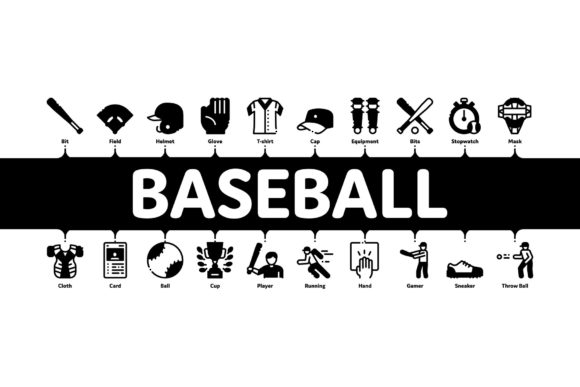
The primary value proposition of this asset lies in its focused iconography. Rather than offering generic baseball clip art, the collection targets specific functional concepts through four distinct pillars: the bat and ball, protective gear (helmet and glove), timing mechanisms (stopwatch), and achievement markers (cup). This curation addresses the most common informational needs in baseball-related content.
- Bat and Ball Dynamics: These illustrations typically focus on form and proportion rather than texture. In a minimal style, this allows the viewer to instantly recognize the equipment without being distracted by wood grain or leather stitching details, making them ideal for diagrams explaining grip, swing mechanics, or field dimensions.
- Safety Equipment Representation: The helmet and glove icons serve a critical role in safety guidelines and rule explanations. A minimal vector approach ensures these symbols remain legible even when scaled down for mobile viewing or printed on small-format handouts.
- Temporal Concepts: Including a stopwatch distinguishes this set from purely decorative packs. It enables creators to visualize game duration, pitch clocks, training intervals, or historical timelines, adding a layer of analytical utility to the design.
- Achievement and Status: The cup concept provides a visual anchor for tournament brackets, award ceremonies, or performance metrics, completing the narrative cycle of preparation, play, and result.
This conceptual completeness means that a designer can build a cohesive narrative arc using a single asset pack, maintaining visual consistency across disparate pieces of content.
Technical Specifications: JPG vs. EPS Utility
For professional users, file format determines workflow efficiency. The availability of both JPG and EPS formats for the Baseball Game Tools Minimal Infographic addresses two distinct stages of the production pipeline.
The Role of EPS in Production
The Encapsulated PostScript (EPS) format is the industry standard for vector graphics and is the primary reason professionals invest in this type of asset. Unlike raster images, EPS files store mathematical paths rather than pixels. This offers several non-negotiable advantages for serious projects:
- Infinite Scalability: Whether the infographic is destined for a social media banner or a large-format stadium signage, the EPS source ensures crisp edges at any resolution. There is no pixelation or artifacting when resizing elements.
- Color Customization: Minimal infographics rely heavily on color theory to convey meaning. With an EPS file, designers can open the asset in Adobe Illustrator, CorelDRAW, or Affinity Designer to globally change color palettes. This allows the asset to match specific brand guidelines or team colors instantly, rather than requiring time-consuming masking or recoloring of raster layers.
- Element Isolation: Vector files typically organize assets into layers or groups. A user can extract just the stopwatch icon for a sidebar while discarding the rest, or rearrange the layout of the web banner to fit a non-standard aspect ratio without losing quality.
JPG for Rapid Prototyping and Web Use
While EPS is the master file, the included JPG serves immediate needs. For bloggers, educators, or marketers working in platforms like WordPress or Canva that may not support native vector editing, the high-resolution JPG provides a ready-to-publish solution. It is particularly useful for mockups, client presentations, or low-stakes internal documents where editability is secondary to speed. However, professionals should view the JPG as a derivative output rather than a primary source.
Practical Applications Across Industries
The versatility of the Baseball Game Tools Minimal Infographic extends well beyond sports journalism. Its clean aesthetic makes it suitable for various professional contexts where baseball serves as a metaphor or a subject matter.
Marketing and Advertising: Agencies creating campaigns for sporting goods, insurance (focusing on safety/protection), or financial services (using the stopwatch/cup as metaphors for growth and success) benefit from the neutral, professional tone of minimal vector art. It avoids the cartoonish nature of stock clip art, lending credibility to corporate messaging.
Education and Coaching: Youth coaches and physical education teachers frequently need visual aids to explain complex rules or drills. A minimal infographic reduces cognitive load for young learners. The clear distinction between equipment types helps in creating safety checklists or equipment guides that are easily understood by parents and players alike.
Editorial and Publishing: Bloggers and digital publishers covering baseball analytics or history require visuals that complement text without overwhelming it. The web banner vector format specifically caters to header images, featured thumbnails, and section dividers, providing a polished look that increases dwell time and perceived authority.
Assessing Quality and Long-Term Value
When evaluating whether to integrate this asset into a resource library, consider the longevity of the design style. Minimalism, characterized by flat colors, geometric simplification, and negative space, tends to age better than hyper-realistic or trend-heavy illustration styles. A realistic 3D render of a baseball glove may look dated within three years as rendering technology evolves, whereas a minimal vector representation remains stylistically relevant for decades.
Furthermore, the consistency of line weight and corner radius across the bat, ball, helmet, glove, stopwatch, and cup is a marker of professional quality. Inconsistent styling is a common failure point in bundled vector packs, where assets appear to be drawn by different hands. A unified Baseball Game Tools Minimal Infographic ensures that mixing and matching elements does not result in a disjointed final composition. This coherence saves designers hours of manual normalization work.
Limitations and Considerations for Buyers
Despite its strengths, this asset type has inherent limitations that users must acknowledge. Minimal infographics prioritize symbolism over detail. If a project requires technical accuracy regarding specific bat regulations, glove webbing patterns, or helmet certification stickers, this style may be insufficient. It is designed for communication and overview, not technical specification.
Additionally, the "minimal" label implies a lack of shading and texture. While this is a strength for UI and print, it can sometimes feel sterile if not paired with appropriate typography and background treatments. Designers accustomed to rich, textured illustrations may find the transition to flat vector requires an adjustment in layout strategy to maintain visual interest.
Finally, licensing terms vary significantly between vector marketplaces. Professionals must verify whether the license covers commercial use, modification, and redistribution. An EPS file is only valuable if the legal framework permits its intended application. Always review the specific EULA associated with the download to ensure compliance with client deliverables.
Integration Into Modern Workflows
To maximize the return on investment for the Baseball Game Tools Minimal Infographic, integrate it into a broader design system. Rather than treating the icons as isolated images, convert them into reusable symbols or components within your design software. In Figma or Adobe XD, these can become part of a sports-themed UI kit. In Illustrator, they can be saved as CC Library assets for instant access across multiple projects.
For web developers, the EPS source can be exported as SVG code, allowing for CSS-driven animations and hover states. A static stopwatch icon becomes interactive when coded to rotate or change color on mouseover, enhancing user engagement on digital platforms. This bridge between static vector art and dynamic web implementation highlights the enduring relevance of high-quality source files.
Ultimately, this asset collection serves as a foundational building block. It solves the immediate problem of needing professional baseball imagery while providing the technical flexibility required for long-term creative adaptation. For the target audience of creators, marketers, and educators, it represents a balance of aesthetic restraint and functional breadth that supports clear, effective communication in a crowded visual marketplace.