Farming Landscape Minimal Infographic: Visualizing Agriculture with Clarity
In an era where digital content competes fiercely for attention, the ability to convey complex agricultural concepts quickly and aesthetically is invaluable. The Farming Landscape Minimal Infographic serves as a bridge between raw data and visual storytelling, offering creators and businesses a streamlined way to present information about rural life, crop cycles, and farm infrastructure. Unlike cluttered, hyper-realistic illustrations that can overwhelm the viewer, minimal vector art distills the essence of farming into clean lines and recognizable shapes. This approach not only enhances readability but also ensures that the core message remains the focal point of any presentation, website, or educational material.
The Anatomy of Effective Agricultural Vector Art
When evaluating assets like the Farming Landscape Minimal Infographic Web Banner Vector, it is essential to understand what constitutes effective minimalism in this niche. True minimal design is not merely about using fewer elements; it is about strategic reduction. Every line, color block, and shape must serve a communicative purpose. In the context of agriculture, this means representing iconic elements without unnecessary texture or shading.
Core Visual Components
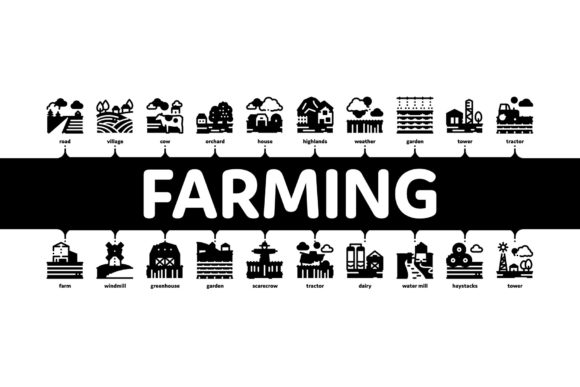
A comprehensive farming infographic package typically includes specific iconography that resonates universally with audiences familiar with rural landscapes. These elements act as visual shorthand, allowing viewers to instantly categorize the content:
- Farming Field And Barn Construction: These structures represent stability, storage, and the physical foundation of agricultural business. In minimal vectors, barns are often reduced to geometric silhouettes that suggest scale and function without architectural noise.
- Mill And Scarecrow: The mill symbolizes processing and energy, while the scarecrow adds a touch of tradition and crop protection. These elements provide narrative depth, suggesting a working landscape rather than a static image.
- Tractor And Cow Farm Animal Illustration: Machinery and livestock are the heartbeat of active farming. Minimalist tractors convey modernization and efficiency, while simplified animal illustrations maintain a friendly, approachable tone suitable for consumer-facing brands.
By combining these components, designers can create a cohesive visual language that speaks to both industry professionals and general consumers. The lack of intricate detail allows these icons to be scaled up for billboards or down for mobile app interfaces without losing legibility.
Practical Applications Across Industries
The versatility of the Farming Landscape Minimal Infographic extends far beyond simple decoration. Its primary value lies in its utility across various sectors that require clear communication regarding food systems, sustainability, and rural development.
Educational Content and E-Learning
Educators and curriculum developers frequently struggle to make agricultural science engaging for students. Dense textbooks often fail to capture the imagination of younger learners. By integrating minimal infographics into lesson plans, teachers can visualize abstract concepts such as crop rotation, irrigation systems, or supply chain logistics. The clean aesthetic reduces cognitive load, allowing students to focus on the relationships between different farm elements rather than deciphering complex artwork.
Corporate Sustainability Reporting
For agribusinesses and food corporations, annual reports and sustainability whitepapers are critical tools for stakeholder communication. These documents are often text-heavy and data-dense. Incorporating a Farming Landscape Minimal Infographic Web Banner Vector can break up walls of text and provide visual anchors for key statistics. For instance, a timeline showing the transition from conventional to organic farming methods is far more digestible when represented by a progression of simple vector icons than when described in paragraphs of technical prose.
Digital Marketing and Web Design
Web designers benefit significantly from the scalability of vector formats. A responsive website requires assets that look crisp on high-resolution retina displays and load quickly on slower connections. Because minimal vectors rely on mathematical paths rather than pixel grids, they offer infinite scalability. Furthermore, the flat design style aligns perfectly with modern UI/UX trends, ensuring that agricultural websites feel contemporary and professional rather than dated or rustic in a cliché manner.
Technical Considerations: JPG vs. EPS Formats
Understanding file formats is crucial for maximizing the utility of these assets. Most premium infographic packages, including those featuring Tractor And Cow Farm Animal Illustration sets, are provided in both JPG and EPS formats. Knowing when to use each is a fundamental skill for non-designers and professionals alike.
- EPS (Encapsulated PostScript): This is the master format. It is a vector-based file that retains all editable paths, layers, and color information. You should always work in EPS when you need to resize the graphic, change colors to match your brand palette, or rearrange individual elements like moving a scarecrow to a different part of the field. EPS files are compatible with professional software like Adobe Illustrator, CorelDRAW, and Affinity Designer.
- JPG (Joint Photographic Experts Group): This is a rasterized output format. It is best used for final deliverables where no further editing is required, such as embedding images in a Word document, uploading to social media, or placing in a PowerPoint presentation. While convenient, JPGs lose quality when enlarged and do not support transparency. Always keep the original EPS as your source of truth.
For users who do not have access to professional vector editing software, many free alternatives like Inkscape can open and modify EPS files, ensuring that the investment in these assets remains accessible regardless of budget constraints.
Evaluating Suitability for Your Project
While the Farming Landscape Minimal Infographic is a powerful tool, it is not a universal solution. Determining whether this style aligns with your specific goals requires careful consideration of your audience and message.
When Minimalism Works Best
This style excels when clarity is paramount. If your goal is to explain a process, compare data points, or create a navigational interface, minimal vectors are ideal. They are particularly effective for B2B communications, tech-forward ag startups, and educational platforms where professionalism and modernity are key brand attributes. The abstraction allows the viewer to project their own understanding onto the image, making it culturally adaptable across different regions.
Limitations and Considerations
Conversely, minimalism may fall short if the objective is to evoke deep emotional nostalgia or showcase specific biological details. For example, a heritage seed company trying to emphasize the unique texture and history of heirloom varieties might find flat vectors too sterile. Similarly, veterinary resources requiring anatomical accuracy cannot rely on stylized Cow Farm Animal Illustrations. In these cases, photography or detailed realism would be more appropriate. Additionally, because minimal art relies on convention, there is a risk of looking generic if the composition is not customized. Users should plan to modify colors, add unique textures, or combine elements in novel ways to avoid the "stock art" appearance.
Best Practices for Implementation
To derive maximum value from assets depicting Farming Field And Barn Construction or machinery, consider the following implementation strategies:
- Maintain Consistent Stroke Weights: If you edit the EPS files, ensure that any new lines you draw match the existing stroke width. Inconsistency in line weight is the fastest way to break the illusion of a unified design system.
- Leverage Negative Space: Minimal infographics thrive on breathing room. Do not feel compelled to fill every corner of the canvas. White space directs the eye and reinforces the importance of the included elements.
- Color Psychology: While green and brown are standard for farming, consider how color influences perception. Brighter greens suggest innovation and growth, while muted earth tones imply sustainability and tradition. Use your brand colors strategically within the vector elements to create association.
- Contextual Pairing: Pair the infographic with concise, complementary copy. The image should not repeat the text verbatim; instead, it should visualize what the text explains. This dual-coding approach improves retention and engagement.
Future-Proofing Your Visual Assets
Investing in high-quality vector assets like the Farming Landscape Minimal Infographic is a long-term strategy. As design trends evolve, the fundamental geometry of minimal art tends to age better than trendy, effect-heavy styles. By maintaining organized libraries of EPS files, businesses can quickly adapt to new campaigns without commissioning entirely new artwork from scratch. Whether illustrating the complexities of modern agronomy or simply adding charm to a local farmer’s market flyer, these versatile tools empower creators to communicate the vital story of agriculture with precision, beauty, and enduring relevance.